The numbers on an EMF meter tell you how strong a field is at the exact spot where the meter sits. There are only three unit families you need to know: µW/m² for radio-frequency (RF) signals, mG for magnetic fields, and V/m for electric fields. Once you can read those three, the screen on a home meter stops being a puzzle.
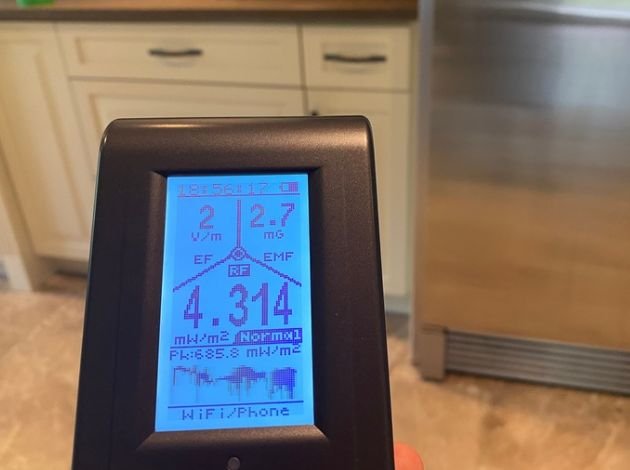
This is the reference page for the whole site. The readings I publish use these units, so bookmark this one and come back whenever a number looks unfamiliar.
Key Takeaways
- Three units cover everything: µW/m² (RF), mG (magnetic), V/m (electric). Each matches one of the three field types.
- mG and µT measure the same thing. 1 µT = 10 mG. Different regions, same field.
- Most RF readings jump around, because most wireless devices transmit in bursts. Learn to read the peak, not chase the flicker.
- Most numbers only mean something in comparison: against your own baseline, the official limits, or the stricter building-biology targets. A reading at the top of your meter’s range is the exception, and tells you something on its own.
First, Know Which Field You Are Reading
A home meter measures three different kinds of fields, and each has its own unit. If you are not sure what the three field types are, start with What Is an EMF Meter and Which Type Do You Need? and come back.
The mode switch on your meter picks the field. The unit on the screen follows the mode. Mixing them up is the number one beginner mistake, so check the mode before you trust the number.
RF Readings: µW/m² and mW/m²
RF meters measure power density: how much radio-signal energy is landing on a patch of space. The standard unit is µW/m², microwatts per square meter. Picture rainfall. Power density is how much rain is falling on one square meter of ground, except the rain is radio energy from WiFi, cell signals, and Bluetooth.
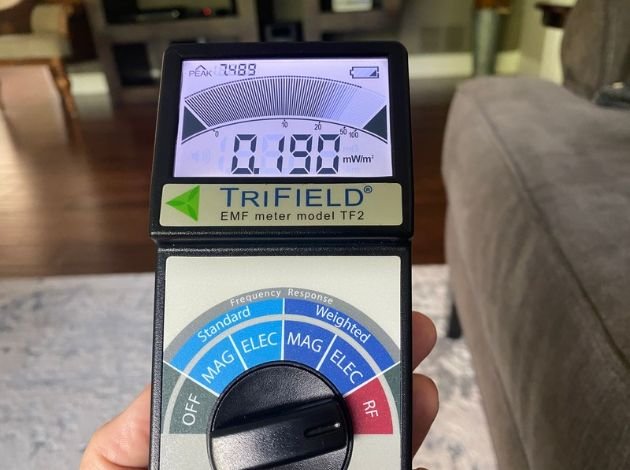
Here is the wrinkle: meters do not all display the same size of unit. My TriField TF2 shows mW/m², milliwatts per square meter. One milliwatt is a thousand microwatts, so the conversion is simple:
1 mW/m² = 1,000 µW/m²
So when my TF2 reads 14.5 mW/m² three feet from my router under load, that is 14,500 µW/m². Same measurement, different label. When you compare readings from different sources, convert to the same unit first, or the comparison means nothing.
From my own testing: ten feet from that router, the TF2 caught peaks up to 7.5 mW/m² while the live display sat between 0.002 and 0.2 mW/m² most of the time. That rhythm of spike and quiet is what a working WiFi network looks like on a meter, and it is why a single glance at the screen tells you almost nothing.
Magnetic Readings: mG and µT
Magnetic field meters measure field strength around flowing electricity. In the US, the common unit is mG, milligauss: one-thousandth of a gauss. In Europe and in most research papers, the unit is µT, microtesla.
They measure the exact same thing. The conversion never changes:
1 µT = 10 mG
So a study that mentions 0.4 µT is talking about 4 mG. A meter reading of 25 mG is 2.5 µT. On this site I use mG, because that is what US meters display, and I give the µT version when I cite research.
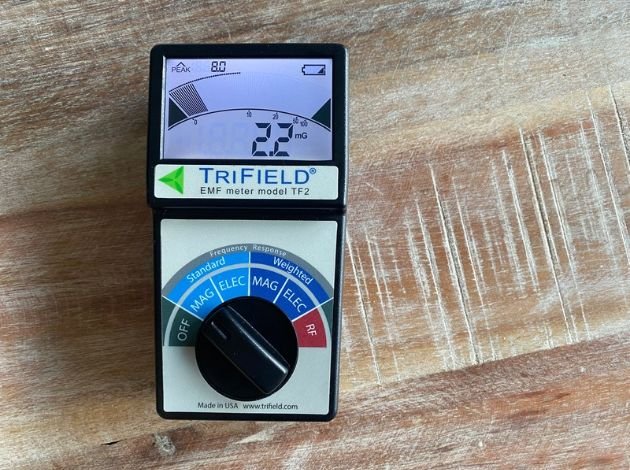
From my own testing: the middle of my living room reads about 2.2 mG on the TF2’s magnetic setting, and about 2.7 mG on my GQ EMF-390 in the same spot. Six inches from my running microwave, the TF2 reads 10 to 13 mG, climbing to as much as 24 mG at an inch. Four feet away it is back to the same number as the room.
Worth knowing: my whole house sits around 2 to 4 mG with nothing switched on, in every room I have measured. That is higher than I expected, it is not coming from an appliance, and I have not traced it yet. Yours may be far lower. It is one more reason to measure your own place rather than borrow my numbers.
Electric Readings: V/m
Electric field meters measure in V/m, volts per meter. Voltage is electrical pressure, and V/m describes how strong that pressure is across a given distance. Anything plugged in has an electric field around it, even switched off, because the pressure is present the moment the cord connects to the wall.
Electric mode is the touchiest of the three. Your own body affects the reading, because you are conductive. Hold the meter the same way every time so your readings stay comparable to each other.
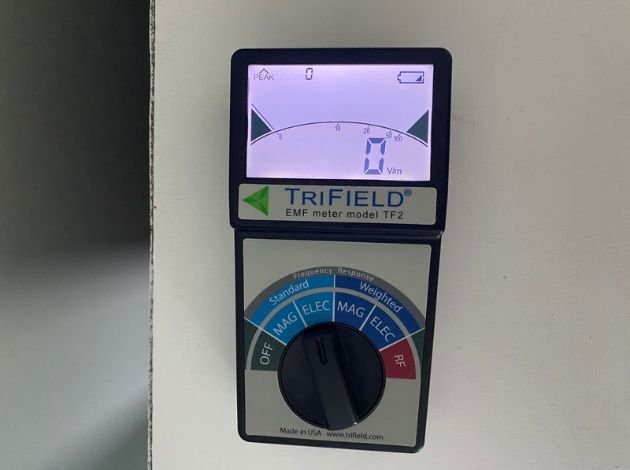
From my own testing: an inch from my bedside lamp cord, the TF2 in electric mode reads 221 V/m with the lamp switched off. With the lamp switched on, it reads 221 V/m. Unplugged, it reads 0. A foot away from the cord, it reads 39 to 46 V/m, and in the middle of that same bedroom, away from any cord, it reads 0.
The switch changing nothing is the lesson. The field is coming from voltage sitting in the cord, not from current flowing through it, so switching off does nothing and unplugging does everything.
Peak vs. Average: The Setting That Changes Everything
Many meters, including the TF2, show two numbers at once: a live reading and a peak. They answer different questions.
The live reading tells you the level right now. The peak holds the highest burst the meter caught. RF sources like WiFi transmit in short bursts, so the live number can look tiny while the peaks are much higher. Neither number is wrong. They describe different things.
My rule, and the way I report readings on this site: for RF, I report the peak and say so. For magnetic and electric fields, which are steadier, the live reading is usually the honest number. Whenever a reading fluctuates, I give a range instead of pretending one number tells the story.
How to Take an EMF Meter Reading You Can Trust
- Set the mode for the field you want, and note the unit on screen. Magnetic, electric, and RF are different quantities. Never compare a number from one against a number from another.
- Take a baseline first. Before you unplug or move anything, walk the room slowly and note the range: where it reads lowest, where it reads highest. That gives you something to compare individual sources against, and if the baseline itself is high across the whole room, that is worth tracing on its own. Mark one spot you can find again, because you will come back to it.
- Now approach the source slowly and watch how the number climbs. This part is exploratory, so move freely. The climb tells you more than any single value. If your meter is single-axis, rotate it slowly through all orientations and use the highest reading you see.
- Settle on a distance you can repeat. Once you know where the peak is, stop and pick a distance, and hold the meter the same way every time you log something. A reading without a recorded distance can’t be compared to anything, including your own reading next week, and an inch or two matters more than most people expect.
- Record the peak and the typical level, plus the distance, the meter, the mode, and the time of day.
- Take it again immediately. A quick second look tells you whether the number itself was stable. RF especially won’t give you the same number twice, so what you are checking is whether the pattern holds: same rough peak, same rhythm, same range. If a second look shows something completely different, find out why before you write it down.
- Go back to your marked spot at the end and re-read it. This one checks the room rather than the source. If it doesn’t match what you got at the start, something cycled on or off while you worked (fridge, HVAC, a neighbor’s load) and none of your comparisons hold until you know what.
That is the same log format behind each reading published here, so you can see the conditions behind any number I give you. My full method is on the How I Test page.
So Is My Number High or Low?
Mostly you find out by comparing, and there are three things worth comparing against.
Your own baseline. Take a reading in the middle of the room, away from everything, then measure the spot you care about. If the spot is much higher, you have found a source. If your baseline itself is high, that is a finding too: something is affecting the whole room, and tracing it is the next job.
The official limits. The FCC and ICNIRP publish exposure limits built around preventing tissue heating. Nearly everything you measure at home sits far below them.
The building biology targets. SBM-2015 sets much stricter numbers for sleeping areas, as a precaution rather than as a point where harm begins. Plenty of home readings sit above these while sitting far below the official limits, and both of those things being true at once is the whole reason this site shows you two sets of numbers. The bands are laid out in Building Biology Standards (SBM-2015), Explained.
There is one case where a reading means something on its own: if the number stops climbing because your meter has run out of display, you are close to something strong, and the reading is telling you to step back and measure from farther away.
The readings I actually find in a real house, room by room, are in What Is a Normal EMF Reading in a House?. Where I land personally: I lean closer to the building biology targets than to the official limits, and when getting a number down is free or easy I do it without needing much convincing. Distance usually does it for nothing. If you don’t have a meter yet, the ones I use are in the EMF detectors I own and recommend.
Frequently Asked Questions
What is the difference between mG and µT?
Nothing except the size of the unit and where it is used. They measure the same magnetic field. 1 µT equals 10 mG. US meters usually show mG; research papers and European meters usually show µT.
Why does my EMF meter beep or spike randomly?
Most likely it is reading real RF bursts. Phones, routers, and smart meters transmit in short pulses, so spikes are what a working RF meter is supposed to show. If the spikes seem tied to nothing, walk the room and watch the numbers; the pattern usually points to the source.
Do I need to convert units to use my meter?
Not for everyday use. Pick one unit per field type and stay consistent. You only need the conversions when comparing your readings to a study, a spec sheet, or a meter that displays differently.
What reading should I expect in a normal room?
In my house, the magnetic background sits between about 1.7 and 4 mG depending on the room, electric mode reads 0 in the middle of a room away from cords, and RF background runs from near nothing in the basement up to a few thousand µW/m² in the room that holds the router. Yours will differ, which is the point. The full room-by-room numbers are in What Is a Normal EMF Reading in a House?.
The units are the vocabulary. The next sentence is taking your meter around your own house, one room at a time, starting with a baseline in each. The rest of this section lives on the EMF Meters hub.
Related Reading
- What Is an EMF Meter and Which Type Do You Need?
- Single-Axis vs. Three-Axis Meters Explained
- Meter Frequency Range: Why It Matters
- Does EMF Get Weaker With Distance?