An RF meter can only report signals inside the frequency range its antenna is built for, and that range is printed on the spec sheet in MHz and GHz. If a device transmits outside your meter’s range, the meter shows a low number or nothing at all, not because the signal is absent, but because the meter cannot see it. Frequency range is the single most important spec on an RF meter, and it is the one most people never check.
Here is how to read the spec, where common household signals sit, and what the meters most people own can and cannot see.
Affiliate disclosure: one link on this page is an affiliate link. Buy through it and I may earn a small commission, at no extra cost to you. Full disclosure.
Key Takeaways
- Frequency is how fast a signal’s wave repeats, measured in hertz. Household wireless lives between roughly 600 MHz and 6 GHz.
- A meter’s frequency range is the window it can see through. Signals outside the window read as zero.
- Zero can mean “nothing there” or “nothing this meter can detect.” Only the spec sheet tells you which.
- Most consumer meters, including the ones I own, cannot see millimeter-wave 5G. That is a real blind spot worth knowing about.
Frequency, in Plain Words
Every wireless signal is a wave, and frequency is how many times that wave repeats per second, measured in hertz (Hz). A megahertz (MHz) is a million repeats per second; a gigahertz (GHz) is a billion. Think of frequencies like radio stations: each technology broadcasts at its own spot on the dial.
An RF meter’s antenna is like a radio that only tunes across part of the dial. Inside its range, it hears everything. Outside, silence, no matter how loud the station is.
Where Household Signals Sit on the Dial
The common transmitters in and around a home, roughly from low to high:
- Cell service (4G/5G low and mid bands): about 600 MHz to 4 GHz
- Smart meters: commonly around 900 MHz, some at 2.4 GHz
- DECT cordless phones: about 1.9 GHz
- Bluetooth and most baby monitors: 2.4 GHz
- WiFi: 2.4 GHz, 5 GHz, and newer 6 GHz networks
- Millimeter-wave 5G: 24 GHz and up, in limited urban deployments
Notice that nearly everything lives between roughly 600 MHz and 6 GHz. That is why consumer meters are built around that window: it covers almost every source a home actually has.
What Happens Outside the Window
This is the part that matters. When a signal falls outside your meter’s range, the meter does not show an error or a warning. It just shows a low or zero reading, indistinguishable from a genuinely quiet room.
So a zero has two possible meanings, and the meter cannot tell you which one you are looking at. That is not a flaw or a scandal; it is how antennas work. But it means a reading is only as honest as your knowledge of the spec behind it. A meter that tops out at 3 GHz will calmly under-report a 5 GHz WiFi network all day, and someone who never checked the spec would conclude their network is quieter than it is.
This cuts the other way too, and it is worth saying because scare content exploits it: a dramatic video of a meter screaming next to a device tells you nothing unless you know the meter’s range and what it was actually picking up.
The Millimeter-Wave Blind Spot, Honestly
The newest 5G bands, called millimeter wave, sit at 24 GHz and above. That is far beyond the range of the meters I own, and beyond every all-in-one on the market. If millimeter-wave 5G is deployed near you, none of the meters in most people’s hands will show it.
It is measurable, though. The Safe and Sound Pro mmWave covers 20 to 40 GHz and is built for exactly this band. I do not own one, so I am describing it from its specs rather than from my own readings. It reads nothing else, so it sits alongside a normal RF meter rather than replacing one.
Two pieces of context go with that. Millimeter-wave deployments are limited and short-range, mostly dense urban blocks and venues, because those frequencies fade fast and struggle through walls, and the sub-6 GHz 5G that covers most areas reads fine on an ordinary meter. And the official limits do cover these frequencies: ICNIRP’s 2020 RF guidelines explicitly addressed them, up to 300 GHz.
How to Read a Spec Sheet
Find the line labeled frequency range or RF range on the meter’s spec sheet, and check two things: the bottom and the top of the window.
The top matters most in a modern home. A meter should reach at least 6 GHz to see current WiFi networks fully. The bottom matters if your concern is lower-band signals like some smart meters and rural cell bands.
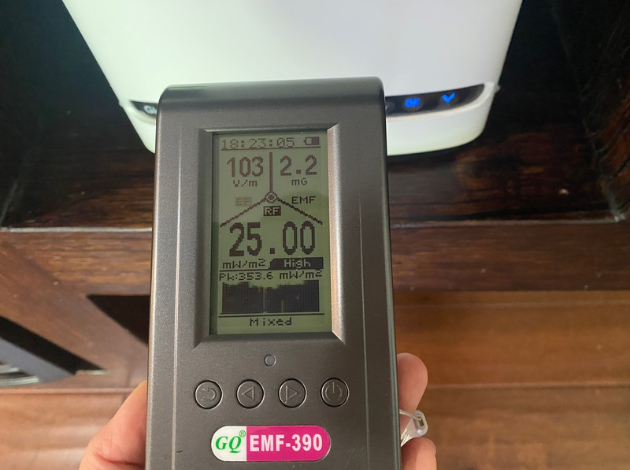
From the meters I own: my TriField TF2’s RF mode is specified from about 20 MHz to 6 GHz. My GQ EMF-390 reaches higher, and it tells you so on its own screen: the RF display labels its band 0.01 to 10 GHz, alongside a separate readout for the 439 MHz region. That spectrum display is genuinely useful, because it shows which part of the window the activity is sitting in rather than collapsing everything into one number.
Check the current spec sheets before buying, since manufacturers revise models. The versions I own are listed on How I Test.
Matching the EMF Meter to Your Question
Frequency range is a fit question, not a quality contest. If your concern is your own WiFi, phones, and neighborhood cell service, any meter covering up to 6 GHz sees all of it. If your concern is specifically millimeter-wave 5G, no all-in-one will answer it and neither will a standard RF meter. There is a meter built for that band, covering 20 to 40 GHz, and it is a separate purchase on top of whatever else you own.
Range is one of the specs I list for each model in my rundown of the best EMF detectors and meters.
Frequently Asked Questions
Can any meter measure everything?
No single meter covers the whole spectrum. Even professionals use different meters for different bands. An all-in-one covering up to 6 GHz sees nearly every source in a normal home, which is why that window is the standard.
Does my meter detect 5G?
Almost certainly yes for the 5G most people have, which runs on sub-6 GHz bands well inside an ordinary meter’s range. No for millimeter-wave 5G at 24 GHz and up, which needs a meter built for that band. That band is also deployed in limited areas.
Is higher frequency more dangerous?
Frequency alone does not equal danger. Everything discussed here sits far below the ionizing threshold, which is the one line on the spectrum where the mechanism for damage is settled, explained in What Is EMF? Ionizing vs. Non-Ionizing. That does not mean the frequencies below it are all equivalent, and researchers are still working on whether the newer higher bands behave differently in the body. Within household RF, the variables you can actually control are power and distance.
Frequency range and axis count are the two specs that quietly decide what your readings are worth; the other one is covered in Single-Axis vs. Three-Axis Meters, Explained. The rest of this section lives on the EMF Meters hub.
Related Reading
- What Is an EMF Meter and Which Type Do You Need?
- How to Read an EMF Meter: What the Numbers and Units Mean
- Single-Axis vs. Three-Axis Meters, Explained
- What Is a Normal EMF Reading in a House?