Yes, and it is the cheapest change you can make. But when I ran the full series with a tape measure, three of my four sources behaved the way the textbook says and one of them appeared to ignore distance entirely. That fourth result turned out to be the most useful thing I measured, and it is the reason most people’s first attempt at this test leaves them confused.
I measured a running microwave, a television, a lamp cord, and two WiFi routers in two different houses, on a TriField TF2 and again on a GQ EMF-390. My own router ran a YouTube stream to a laptop in another room for the entire series, so its traffic load never changed between measurements. Here are the real numbers, and the explanation for the one that looks broken.
Key Takeaways
- Distance lowers readings. That part holds in every test, and it is free.
- The textbook rule, double the distance and the reading falls to a quarter, matched my microwave closely once I accounted for the room’s own background.
- Indoor RF may or may not give you a smooth curve, and the room decides. Reflections create peaks and nulls every two and a half inches at WiFi frequencies, and the swing between them can be larger than the falloff you are trying to measure.
- The fix is technique, not a better meter. Sweep a volume at each distance and record the maximum, rather than taking one reading at one point.
Why Distance Works
Picture a flashlight in a dark room. Up close the beam is a small, intense circle. Step back and the same light spreads over a bigger area, so any single square inch gets less of it. The light did not disappear. It spread thinner.
That is the inverse-square law. For a small source radiating freely, double the distance and the reading falls to a quarter. Four times the distance, a sixteenth.
The phrase doing the work there is “radiating freely.” A room is not free space, and my tests show what that changes.
Test 1: Running Microwave, Magnetic Field
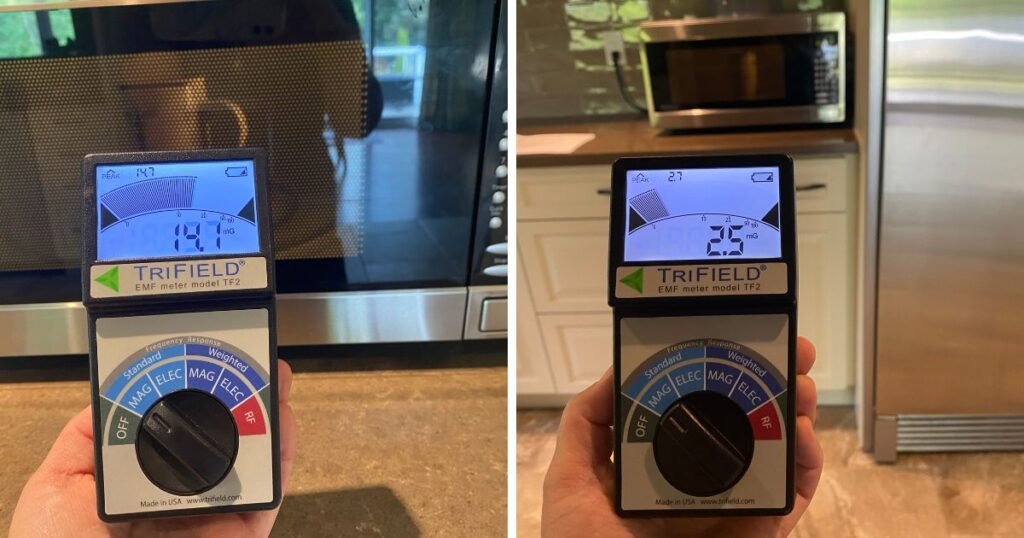
TF2 in magnetic mode, directly in front of the door, oven running.
| Distance | Reading |
|---|---|
| 1 inch | 13 to 24 mG |
| 6 inches | 10 to 13 mG |
| 2 feet | 3.2 to 3.4 mG |
| 4 feet | 2.6 to 2.8 mG |
| 6 feet | 2.7 to 2.9 mG |
This one follows the textbook, but only after one piece of arithmetic.
My house has a magnetic background of about 2.6 mG, which I know because I measured the oven switched off at five distances from one inch to eight feet and got 2.3 to 2.6 mG every time. The meter can never read below that floor, so the raw numbers flatten out and make it look like the falloff stopped.
Subtract the background and the oven’s own contribution comes out clean. At six inches it is about 8.9 mG above the room. At two feet, four times the distance, it is about 0.7 mG above the room. That is a drop of roughly thirteen times where the formula predicts sixteen.
By four feet, the running oven is indistinguishable from the kitchen it sits in.
One detail worth copying: orientation mattered at close range. Pointed at the oven, the meter read 20 mG at an inch. Tilted up at the same inch, it read 13 to 15. That is a three-axis magnetic sensor still being affected by how I held it, which is why I log the angle.
Test 2: Television, Electric Field
TF2 in electric mode, basement television switched on.
| Distance | Reading |
|---|---|
| Almost touching | 538 V/m |
| 1 foot | 224 V/m |
| 3 feet | 89 V/m |
| 6 feet | 44 V/m |
| 9 feet | 24 V/m |
| 13 feet | 5 V/m |
Smooth and steady, the tidiest-looking series I took. But look at what it is doing. From three feet to six, the reading halved. From six to nine, roughly halved again.
Halving per doubling is not inverse square, which would have quartered it. The reading falls more slowly than the formula predicts, and the usual explanation is that a television is not a point. It is a large flat object, and the field near a large object thins out differently from the field near a dot.
My GQ EMF-390 read lower throughout, 246 V/m at contact against the TriField’s 538, but traced the same curve. Two meters disagreeing on the value while agreeing on the shape is a theme of this whole session.
Test 3: Lamp Cord, and the Change That Beats Distance
TF2 in electric mode, bedside lamp.
| Distance and state | Reading |
|---|---|
| 1 inch, light switched off | 221 V/m |
| 1 inch, light switched on | 221 V/m |
| 1 foot | 39 to 46 V/m |
| Middle of the room | 0 V/m |
| Unplugged | 0 V/m |
Twelve times the distance brought the reading down about five times. Slower again than either of the tests above, and for the same reason: a cord is a line, not a point.
The more interesting result is the switch. Flipping the lamp on changed the reading by nothing at all. Unplugging it took the reading to zero. Electric fields come from voltage sitting in the cord, not from current flowing through it, so the only move that matters is the plug.
That is worth knowing because it is the one case where distance is not the best free change available. Nothing you can do with a tape measure beats pulling the plug.
Test 4: WiFi Router, RF. The One That Looks Broken
TF2 in RF mode, straight out from the router, YouTube streaming to a laptop in another room throughout. I measured every foot from one to fourteen.
| Distance | Peak |
|---|---|
| 1 foot | over 20 mW/m² on 3 of 4 readings |
| 3 feet | 10.9 to 14.5 mW/m² |
| 5 feet | 1.3 to 1.9 mW/m² |
| 8 feet | 8.3 to 11.3 mW/m² |
| 10 feet | 0.1 to 7.5 mW/m² |
| 13 feet | 0.008 to 3.6 mW/m² |
Read that again. It reads higher at eight feet than at five.
My GQ EMF-390, run separately over the same distances with the same stream running, did the same thing. Two meters from two manufacturers, same strange shape.
My first thought was that distance had stopped working. It had not. What stopped working was my measurement.
Why Your Router Readings Jump Around
Radio waves reflect off walls, floors, ceilings, appliances and furniture. Your meter receives the direct signal plus a dozen delayed copies of it. Where those copies arrive in phase they add together and you get a peak. Where they arrive out of phase they cancel and you get a null.
Three numbers explain my whole table:
Peaks and nulls repeat every half wavelength. At 2.4 GHz that is about 6.25 cm, two and a half inches. I was stepping a foot at a time, so every step crossed roughly five of them. Each distance was effectively a random draw from that pattern.
Typical indoor variation between a peak and a null is 10 to 20 dB, and near large metal objects it reaches 30 dB. That is a factor of ten to a thousand between two spots a few inches apart, even with clear line of sight.
Across 4 to 13 feet, inverse square predicts only about 10 dB of drop.
There is the answer. The effect I was trying to measure was about 10 dB. The interference pattern sitting on top of it was 10 to 20 dB. The falloff was there the whole time, buried under something larger, like trying to hear someone talk next to a running blender.
My own readings contain the proof. Same chair, same minute, same meter, the only change being which way I pointed it:
| Meter orientation | Reading |
|---|---|
| Pointed at the router | 3.52 and 3.38 mW/m² |
| Pointed away from the router | 0.061 and 0.033 mW/m² |
That is roughly 18 dB from rotation alone, standing still. The TF2’s RF sensor is single-axis, so which way you hold it stacks on top of where you stand. And because the router transmits in bursts rather than continuously, what the peak-hold catches also depends on when you happen to be looking.
Three sources of scatter, each one about as large as the trend underneath them.
A Second Router, in a Different Room
I have since measured a router in a friend’s basement laundry room, backing out through an open door with a clear line to it the whole way, and the numbers fell steadily the entire time. Textbook. Same meter, same method, nothing like my living room.
I cannot tell you exactly which difference did it. The rooms differ in size, in what is on the walls, in what furniture sat near my measuring path, and my own router was busy streaming to a laptop in another room, which means it was aiming most of its signal somewhere I was not standing.
What I can tell you is the principle underneath both results. Where the straight-line signal clearly outweighs what is bouncing off the walls, you get the curve from the diagram. Where the two are comparable, where you stand matters as much as how far away you are. You cannot tell by looking which room you are in. You find out by measuring, and if your numbers jump around, that is information about your room rather than a fault in your meter.
How to Measure Falloff Properly With an EMF Meter
This is standard practice in RF surveying, and it is the difference between a table that means something and the one above.
Sweep a volume, do not sample a point. At each taped distance, move the meter slowly through about a foot in every direction while rotating it, for ten or fifteen seconds, and record the highest reading. That crosses several interference cycles instead of freezing you at one arbitrary phase.
Offset your positions. Measuring at exactly one-foot intervals can land you on minima again and again. Shift the spacing slightly between runs.
Hold the traffic steady. Mine streamed video the whole time, which is why I can rule out changing load as the cause of the scatter. If your router goes idle halfway through, your series is measuring two different things.
Say which number you are reporting. A peak-hold maximum from a volume sweep is not the same statistic as a live reading at a point, and the two are not comparable.
None of this applies to the magnetic and electric tests above. Those fields do not produce interference patterns at these scales, which is exactly why those three series came out smooth and the RF one did not.
What This Means in Practice
Distance works. In every test, closer was worse and further was better, and all of those changes were free.
What distance will not always give you indoors is a tidy curve you can predict with a calculator:
Magnetic fields from small appliances follow the textbook closely once you account for your room’s background. Four feet is usually plenty.
Electric fields fade steadily and predictably, more slowly than the formula says. A foot or two of separation does most of the work, and unplugging does the rest.
RF indoors falls off, but in some rooms the reflections make the reading at any single point unreliable. Measure across a volume or do not trust the number.
None of this says anything about health. It says what happens to a reading as you step back, which is a measurable fact regardless of where you land on caution. The official limits from the FCC and ICNIRP sit far above everything in these tables, and building biologists working with cautious clients use much stricter precautionary targets for sleeping areas.
My own rule covers this case exactly: when lowering a reading is free, cheap, or easy, I do it. Moving a router a few feet, or charging a phone across the room instead of on the nightstand, costs nothing. Where the change gets expensive is where I want better evidence first.
Frequently Asked Questions
How far does EMF travel from a router?
Far enough to cover your house, which is the point of WiFi. Strength and reach are different things, though. The first few feet do most of the work, and past that the room’s reflections can matter as much as the distance does.
Why do I get different readings at the same distance?
Because at WiFi frequencies, peaks and nulls in the reflected signal repeat every two and a half inches or so, and a swing of ten to twenty times between them is ordinary. Four of my readings at one taped foot, taken inside a minute with nothing moved, ran from 0.08 to over 20 mW/m². Your meter is not broken. It is reporting the room.
Is doubling the distance the same as cutting the reading in half?
It depends which field and which source. My microwave’s magnetic field dropped close to the textbook quarter. My television’s electric field dropped by about half. My own router’s RF did neither in any way I could resolve by standing in one spot.
Does this mean distance doesn’t help with WiFi?
No. It means a single reading at a single point is a poor way to prove it. Sweep a volume at each distance, take the maximum, and the trend comes back. In my friend’s house the same test gave a clean curve from the start, so it very much depends on the room.
Why did two meters give different numbers?
They do. Mine disagreed by about threefold on electric field. What matters is that they agreed on the shape of every curve, including the awkward one. When two meters disagree on a value but agree on a pattern, trust the pattern.
Once you have seen how differently the three field types fade, the next useful piece is telling them apart in the first place, in RF vs. Magnetic vs. Electric Fields. The rest of this pillar lives on the Understanding EMF hub.
Related Reading
- What Is EMF? Ionizing vs. Non-Ionizing, in Plain Words
- RF vs. Magnetic vs. Electric Fields: What’s the Difference?
- How to Read an EMF Meter: What the Numbers and Units Mean
- What Is a Normal EMF Reading in a House?
Sources