An EMF meter is a handheld device that measures electromagnetic fields, the invisible energy given off by things like WiFi routers, power lines, phone chargers, and kitchen appliances. Instead of wondering how much is around you, a meter puts a number on it. There are three main types: RF meters, magnetic field meters, and electric field meters. All-in-one meters combine all three in one box, and for most people, that is the right first purchase.
I will walk you through what each type actually detects, show you real readings from my own home, and help you figure out which one fits what you want to measure.
Key Takeaways
- An EMF meter measures invisible electromagnetic energy and shows it as a number, so you can compare, test, and decide for yourself.
- There are three kinds of fields in a home: radio frequency (RF), magnetic, and electric. Each needs a different sensor.
- No single sensor catches everything. That is why all-in-one meters exist.
- For a first meter, I recommend an all-in-one. It is the fastest way to learn what is actually in your space.
What an EMF Meter Actually Does
EMF stands for electromagnetic field. It is energy that travels through space around anything electrical or wireless. You cannot see it, hear it, or feel it, which is exactly why people either ignore it or fear it.
A meter fixes that. Think of it like a light meter, except for a kind of light your eyes cannot pick up. Point it at a router or hold it near an outlet, and it tells you how strong the field is right there, right then.
That number is the whole point of this site. Once you have a reading, you can compare it against two useful benchmarks. The first is the official exposure limits from the FCC and ICNIRP, the international body that sets exposure guidelines. Nearly every reading you take at home will land far below those limits.
The second benchmark comes from building biology, a field that inspects homes for cautious clients. Its SBM-2015 guidelines are precautionary targets for sleeping areas, and they are hundreds to thousands of times stricter than the official limits. They are not government health limits. They are a “keep it as low as you reasonably can” approach to the room you spend eight hours a night in.
I lean closer to the building biology targets than to the official limits, because I think the long-term research is still open. I show you both benchmarks and what I personally do, so you can draw your own line. My own rule is simple: when a change is free, cheap, or easy, I make it. When it costs real money, I think harder about it, and sometimes I spend it anyway.
One important line to draw before we go further: home EMF meters measure non-ionizing radiation. That is the low-energy kind from WiFi, wiring, and appliances. They do not detect ionizing radiation, the high-energy kind like X-rays. Those are completely different measurements requiring completely different meters, and any product that blurs that line is a red flag.
The Three Kinds of Fields in Your Home
Here is the part most beginner guides skip. “EMF” is not one thing. In a home, there are three different kinds of fields, and each one comes from a different source and needs a different sensor to detect it.
A loose way to picture it: think of three kinds of invisible weather. RF is like a breeze that carries signals through the air. Magnetic fields are like a bubble around anything with current flowing through it. Electric fields are like static hanging around anything plugged in, even when it is switched off.
Let’s take them one at a time.
RF Meters (Radio Frequency)
RF stands for radio frequency. These are the signals that carry wireless information: WiFi, cell service, Bluetooth, smart meters, baby monitors, cordless phones.
RF meters usually measure in µW/m², microwatts per square meter. That is a measure of how much radio-signal energy is landing on a given patch of space, the way rainfall is measured in inches falling on a square of ground. (My TriField displays milliwatts per square meter; 1 mW/m² equals 1,000 µW/m².)
This is the field type most people are asking about when they worry about radiation from their router or a nearby cell tower. It is also the one that changes the most from minute to minute, because devices transmit in bursts. The first time I measured my own router, the number would not sit still, and I did not understand why. Most of the wireless things in a home transmit in bursts rather than steadily, so the reading rises and falls as data moves. Not everything behaves that way, a cordless phone base station transmits more or less continuously, but for routers and phones a moving number is normal.
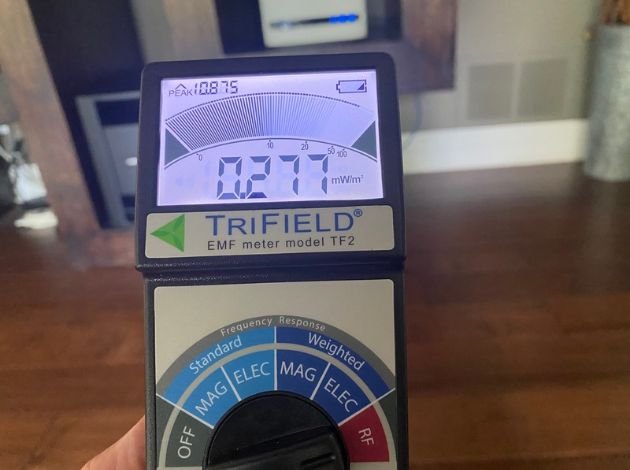
From my own testing: with my TriField TF2 in RF mode one foot from my WiFi router while a video streamed, three of my four readings ran off the top of the display. The TF2 stops at 19.999 mW/m², so what I know is that the level was above that, not how far above. Ten feet away, across the room, peaks ranged from 0.1 to 7.5 mW/m².
Notice that second number is a range rather than a figure. Four readings at one taped foot, taken inside a minute with nothing moved, ran from 0.08 to over 20. That spread is not a faulty meter. It is what a burst transmitter looks like, and it is the first thing a new owner has to make peace with.
One spec to watch: frequency range. An RF meter only reports signals inside the range its antenna is built for, and this is different from running out of display. If a signal is stronger than the display can show, the number simply stops at the top and stays there, which is obvious. If a signal sits outside the frequency range, you get a low reading or nothing at all, with no warning that anything was missed. I cover this fully in Meter Frequency Range: Why It Matters.
Magnetic Field Meters (Gauss Meters)
Magnetic fields come from electric current, meaning electricity actually flowing and doing work. Sources include power lines, your electrical panel, motors, and appliances that are running. These meters are often called gauss meters, after the unit.
In the US, home magnetic readings are usually shown in mG, milligauss. One milligauss is one-thousandth of a gauss, a unit of magnetic field strength. (Elsewhere you will see µT, microtesla. The conversion is simple: 1 µT equals 10 mG.)
Magnetic fields have two habits worth knowing. First, they fall off very quickly with distance from most household sources. Second, they pass through nearly everything, walls included, so shielding them is genuinely hard. Measuring and stepping back is almost always the practical answer.
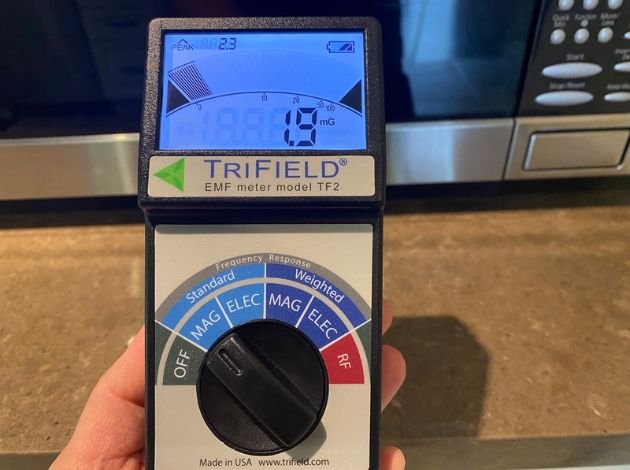
From my own testing: my microwave, while running, reads 10 to 13 mG at six inches from the door on the TF2’s magnetic setting, climbing to as much as 24 mG at an inch. At four feet it reads 2.6 to 2.8 mG, which is the same as my kitchen reads with the oven switched off. The oven is strong at the door and gone by the time you have crossed the room.
That background level is worth a note of its own. My kitchen sits around 2.7 mG with nothing running, and so does the rest of my house. That is higher than I expected, it is not coming from an appliance, and I have not traced it yet. Yours may be far lower, which is the whole argument for measuring your own place.
Gauss meters are also the tool for finding wiring errors, mistakes inside walls that create elevated magnetic fields where you would never expect them. That is one of the most useful and least talked-about things a meter can find.
Electric Field Meters
Electric fields come from voltage, which is electrical pressure that exists whenever something is plugged in, even if it is turned off. A lamp that is off but still plugged into the wall has an electric field around its cord. Flip the lamp on, and now current flows and a magnetic field shows up too.
Electric field meters measure in V/m, volts per meter, which describes how strong that electrical pressure is across a given distance.
This is the most overlooked of the three field types. Bedrooms are where it matters most, because we spend hours a night with our heads a foot or two from plugged-in lamps, chargers, and cords behind the headboard.
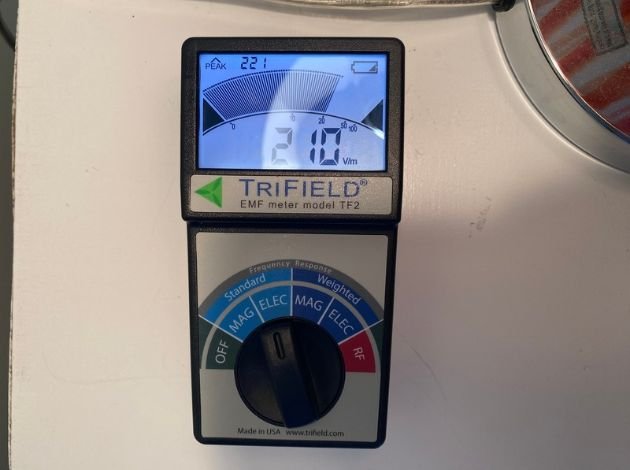
From my own testing: the TF2 in electric mode reads 221 V/m an inch from my bedside lamp cord with the lamp switched off. With the lamp switched on, it reads 221 V/m. Unplugged, it reads 0. A foot away from the cord, it reads 39 to 46 V/m, and in the middle of that same bedroom, away from any cord, it reads 0.
The switch changing nothing is the lesson. The field is coming from voltage sitting in the cord, not from current flowing through it, so switching off does nothing and unplugging does everything.
All-in-One EMF Meters
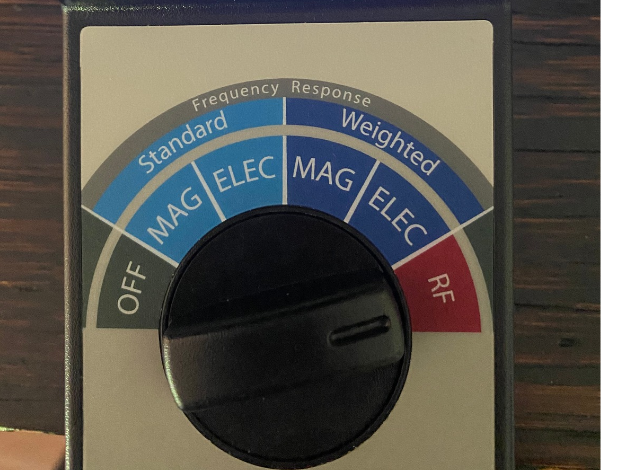
An all-in-one packs an RF sensor, a magnetic sensor, and an electric sensor into one device with a mode switch. The TriField TF2 and the GQ EMF-390, the two meters I test with most, are both all-in-ones.
The honest tradeoff: an all-in-one is a generalist. A dedicated RF meter like the Safe and Sound Pro II reads far fainter signals than the TF2 does, and it is more accurate: each unit is individually calibrated and ships with a calibration certificate, which the TF2 does not. It also handles much stronger signals before its display maxes out. But it reads radio frequency only, so you would need something else for magnetic and electric fields, and the cost adds up fast.
For a first purchase, the all-in-one wins easily. You do not yet know which field type matters in your home. Buying all three sensors in one box lets the meter itself answer that question.
One more thing to check when comparing models: single-axis versus three-axis sensors. A three-axis sensor reads from all directions at once, so the number does not change when you turn the meter. A single-axis sensor has to be rotated to find the strongest angle.
This is often mixed within one device. The TF2, for example, is three-axis for magnetic fields but single-axis for electric and RF, which means how you hold it matters for two of its three modes and not the third. I go through this in Single-Axis vs. Three-Axis Meters, Explained.
Which Type Should You Buy First?
Here is the short decision guide I give friends and family before I do a walkthrough of their home:
You are new to all of this and just want to know what is in your space. Buy an all-in-one. This is most people.
You have one specific concern that is wireless. A cell tower nearby, a smart meter on the bedroom wall, a neighbor’s router. A dedicated RF meter gives you more for that one job.
Your concern is power lines, your electrical panel, or appliances. That is magnetic field territory, so a good gauss meter is the tool.
You already own an all-in-one and want to go deeper. Now a dedicated meter starts to make sense.
Whatever you choose, the meter is only half of it. Knowing what the numbers mean is the other half, and that is covered in How to Read an EMF Meter: What the Numbers and Units Mean.
What I Use and How I Test
The readings on this site come from my own testing, in my own home or in the homes of friends and family who ask me to measure theirs. I test mostly with a TriField TF2 and a GQ EMF-390, the meters most people end up buying.
I log the meter, mode, distance, and time so you can see the conditions behind a number, and so you can run the same kind of test in your own home. Your numbers will not match mine, because your sources and your walls are different, and that is the point of owning a meter rather than reading someone else’s. What I use and how I go about it is on my How I Test page.
I am not a doctor or an engineer. I am a parent who bought a meter because I was tired of being scared by websites that wanted to sell me something. The readings above are what my meters showed in my house; yours will differ, and that is exactly why owning one is worth it.
Frequently Asked Questions
Do EMF meters detect all types of radiation?
No. Home EMF meters measure non-ionizing fields: RF, magnetic, and electric. They do not detect ionizing radiation like X-rays, and they are not Geiger counters.
What is a normal EMF reading in a house?
It varies by room and by field type, which is why I publish the real numbers I find rather than a rule of thumb. In my own house, background magnetic levels away from appliances run between about 1.7 and 4 mG, and electric mode reads 0 in the middle of a room away from cords. The full room-by-room figures are in What Is a Normal EMF Reading in a House?.
Can my phone work as an EMF meter?
Only partly, and not for the part most people care about. Phones have a magnetometer (a compass sensor), so apps can show rough magnetic readings. But a phone cannot measure RF from WiFi or cell signals, because its radios are built to communicate, not to measure.
How much does a good EMF meter cost?
The all-in-one meters I use sit in the mid-range of the consumer tier. Dedicated professional meters start in the hundreds and climb quickly. You do not need professional meters to take useful, repeatable readings at home; my picks are in the EMF detectors I own and recommend.
If you are ready to pick a meter, start with my tested picks, where I compare the models I have actually measured with. If you already have a meter in hand, the natural next step is learning what its numbers mean. The rest of this section lives on the EMF Meters hub.
Related Reading
- How to Read an EMF Meter: What the Numbers and Units Mean
- Single-Axis vs. Three-Axis Meters, Explained
- Meter Frequency Range: Why It Matters
- What Is a Normal EMF Reading in a House?