There is no single normal reading. What there is, and what this page publishes, is what a real house actually reads when somebody walks it with a meter and writes down what the display said.
Right now that is one house: mine, measured over two evenings in August 2026 with two meters, logged with mode, distance and time. One house is not a survey. Treat what follows as a worked example rather than a standard, and check your own rooms against each other rather than against mine.
This page grows as I measure more homes. As it does, single numbers become ranges.
I have walked other homes with the same meters, friends’ and family’s, and nothing I saw in them landed outside what you see below. I am telling you that as an impression rather than as evidence. Those visits were not logged to the standard these tables hold themselves to, and an impression does not belong in a table.
Key Takeaways
- Homes logged in full: 1. Others walked informally, with nothing that contradicted these numbers.
- RF and electric backgrounds were quiet mid-room. The magnetic background was not, and it was the same in every room I checked.
- The loudest readings in the house came from being close to one small device, not from the building.
- Two pillows in the same house, one hallway apart, read about a thousand times apart.
How to Read This Page
Two numbers are logged for most readings. The peak is the highest the meter caught and held. The typical is what the display was showing at the moment I wrote it down. RF bursts by nature, so RF gets both. Magnetic and electric fields hold steadier, so those are typical readings unless noted.
Unit note: 1 mW/m² is 1,000 µW/m². Small numbers are easier to read in µW/m² and large ones in mW/m², so this page uses both and labels each one.
Nothing here is a safety threshold. For the two benchmarks people compare readings against, see Building Biology Standards (SBM-2015), Explained. The method behind every figure is on How I Test.
Which EMF Meters Took These Readings
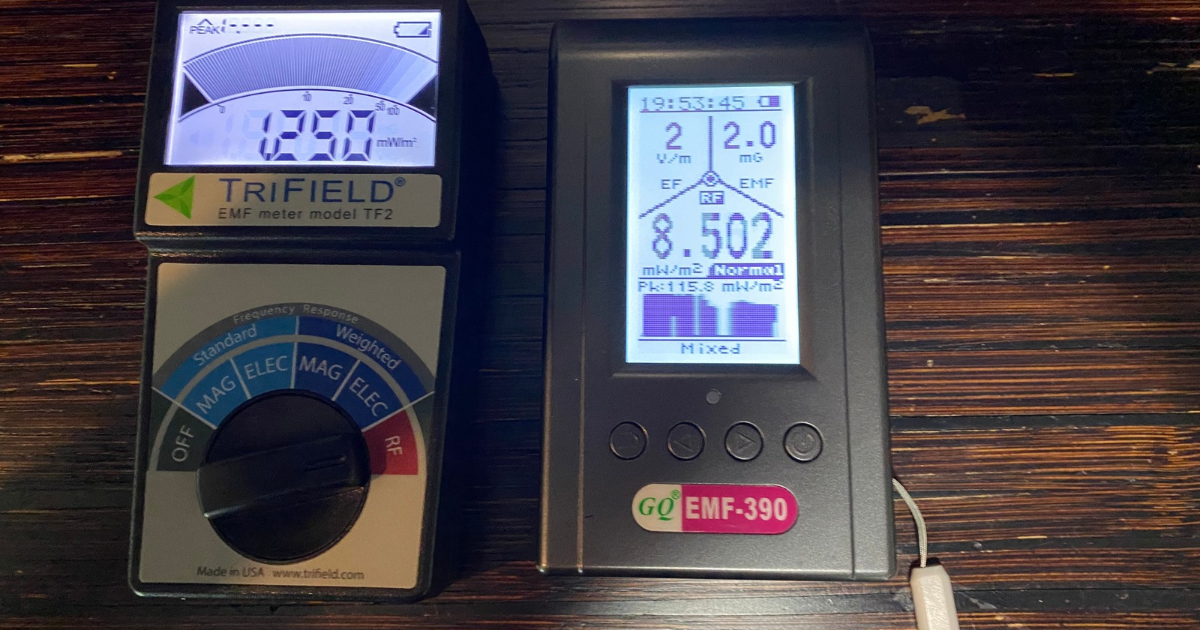
A TriField TF2 and a GQ EMF-390, both bought by me. Where both meters measured the same spot, both numbers are shown, because they did not always agree and hiding that would defeat the purpose of carrying two.
Room Backgrounds
Taken mid-room, away from devices and walls, with the house running normally.
Magnetic, in mG
| Room | Reading |
|---|---|
| Kitchen | 2.7 (GQ only) |
| Dining room | 3.0 TriField, 4.1 GQ |
| Living room | 2.2 TriField, 2.7 GQ |
| Bedroom | 1.7 TriField, 2.2 to 2.4 GQ |
| Basement | 2.2 TriField, 2.9 GQ |
Electric, in V/m
| Room | Reading |
|---|---|
| Dining room | 0 |
| Living room | 0 |
| Bedroom, at the pillow | 0 to 2 |
| Basement | 0 |
RF, in µW/m²
| Room | Peak / typical |
|---|---|
| Living room (router in it) | 5,940 / 129 |
| Bedroom, quiet one | 82 to 196 / 3 to 7 |
| Basement | 97 / 0 |
The Magnetic Floor Is the Surprise
The thing I did not expect was that the magnetic background barely changed from room to room. Roughly 2 to 4 mG everywhere, basement included, with nothing switched on.
I have a control for it by accident. Before testing the microwave I measured it switched off, at five distances from one inch out to eight feet, and got 2.3 to 2.6 mG every time. That is not an oven. That is the house.
Both meters saw it, with the GQ reading consistently a few tenths of a milligauss above the TriField in the same spot. A floor that even does not come from an appliance. The usual explanations are current returning on something other than the neutral wire, or proximity to the service drop, and I have not yet traced mine. That is its own session, at the panel and along the plumbing, and it will get its own article when I have done it.
For now I am reporting it rather than explaining it, because I do not know the answer yet.
RF by Source and Distance
Peaks under load, taped distances, router streaming video to a laptop in another room.
| Source and distance | RF peak |
|---|---|
| Router, 1 ft | over 20 mW/m² TriField, 26 to 33 mW/m² GQ |
| Router, 3 ft | 10.9 to 14.5 mW/m² TriField, 10.8 mW/m² GQ |
| Router, 10 ft | 0.1 to 7.5 mW/m² TriField, 6.2 to 9.2 mW/m² GQ |
| Microwave running, 1 in | over 20 mW/m² TriField, 670 to 686 mW/m² GQ |
| Microwave running, 2 ft | 7.8 to 9.0 mW/m² TriField, 5.7 to 23.9 mW/m² GQ |
| Microwave running, 6 ft | 1.8 to 5.2 mW/m² TriField, 2.7 to 3.1 mW/m² GQ |
“Over 20” is not me rounding. The TriField’s RF range stops at 19.999 mW/m², so when it pegs, what I know is that the level was above that and not how far above.
Two honest notes. The router readings did not fall off cleanly with distance the way I expected. They dropped steeply over the first three or four feet, then sat on a plateau that barely moved from four feet out to thirteen, then dropped again. Both meters showed the same shape, so it is the room and not the meter. Indoors, RF reflects, and past a few feet you are measuring a room rather than a distance. The clean version of falloff, and where it does hold, is in How EMF Weakens With Distance.
And at one taped foot from the router, inside a minute, four readings ran from 0.08 to over 20 mW/m². That spread is the most useful thing in this whole page.
Two Bedrooms, One Hallway Apart
The highest RF in the house came from a wireless access point on a bedroom wall. The bed starts three feet from it. The near pillow sits just under four feet.
| Position | RF peak |
|---|---|
| Beside the access point | over 20 mW/m² TriField, up to 579 mW/m² GQ |
| Near pillow, just under 4 ft | over 20 mW/m² TriField, 18.7 mW/m² GQ |
| Far pillow, about 7 ft | 4.2 to 13.8 mW/m² TriField, 6.3 mW/m² GQ |
| Pillow in the bedroom across the hall | 0.08 to 0.2 mW/m² TriField, 0.002 to 0.008 mW/m² GQ |
Same house, same evening, same meters, one hallway between them. Roughly a thousandfold difference, and it comes from one small device on a wall.
That is the clearest argument I have found for why borrowed numbers are worthless. Nothing about the building explains it. If I had measured only the quiet bedroom I would have concluded the house was fine, and if I had measured only the other one I would have concluded the opposite.
The two meters agreed closely on the peaks at that pillow and disagreed by about tenfold on the typical readings, which is a real limitation worth knowing about rather than smoothing over.
Magnetic by Source and Distance
| Source and distance | Magnetic |
|---|---|
| Microwave off, any distance | 2.3 to 2.6 mG (house background) |
| Microwave running, 1 in | 13 to 24 mG TriField, 20 mG GQ |
| Microwave running, 6 in | 10 to 13 mG TriField |
| Microwave running, 2 ft | 3.2 to 3.4 mG TriField |
| Microwave running, 4 ft | 2.6 to 2.8 mG, back to background |
The oven is the cleanest falloff in the house. Strong at the door, gone by four feet.
Orientation mattered at close range. Pointed at the oven the meter read 20 mG; tilted up at the same inch it read 13 to 15. That is a three-axis magnetic sensor still being affected by how I held the thing, and it is why I log the angle.
Electric by Source and Distance
| Source and distance | Electric |
|---|---|
| Lamp cord, 1 in, light on | 221 V/m TriField, 67 V/m GQ |
| Lamp cord, 1 in, light off | 221 V/m TriField, 69 V/m GQ |
| Lamp cord, 1 ft | 39 to 46 V/m TriField, 17 to 19 V/m GQ |
| Lamp unplugged | 0 |
| Router, 1 in | 423 V/m |
| Router, 3 ft | 20 to 23 V/m |
| Television on, contact | 538 V/m TriField, 246 V/m GQ |
| Television, 3 ft | 89 V/m TriField, 58 to 60 V/m GQ |
| Television, 13 ft | 5 V/m TriField, 1 V/m GQ |
The lamp is the one to look at twice. Switching it off changed the reading by nothing at all. Unplugging it took the reading to zero. Electric fields come from voltage sitting in the cord, not from current flowing through it, so a lamp that is off but plugged in is still producing a field. Both meters agreed on that, and disagreed by roughly threefold on the size of it.
The television gave the tidiest distance series I took, roughly halving for each doubling of distance.
What One House Tells Me So Far
Electric and RF backgrounds were quiet mid-room, and magnetic was not. Standing in the middle of a room, away from things, the RF and electric readings were near nothing. Magnetic never went below about 1.7 mG anywhere.
The loud readings belonged to proximity. Every reading above background in this house traced to being within a few feet of one object, not to the building.
The two meters agreed on shape and disagreed on size. They tracked each other on which way a number moved and by roughly how much, and differed by a factor of three on electric field and ten on typical RF. Treating any single number as the number is a mistake I am now able to prove rather than assert.
I am not going to tell you what any of that means for health, and nothing above is a safety threshold. What the numbers are compared against, and what the two published benchmarks say, is in Building Biology Standards (SBM-2015), Explained.
Frequently Asked Questions
Is my reading high?
This page cannot tell you that, and anyone with one house of data who says otherwise is overselling. What it can do is show you whether your numbers are in a familiar neighbourhood or wildly outside one. Whether a reading is acceptable is a separate question with two published benchmarks and a personal decision attached.
Why don’t my numbers match yours?
Different house, different meters, different moment. My own two meters disagreed with each other in the same room on the same evening. Comparing your rooms against each other, and against themselves before and after a change, carries far more information than comparing them to mine.
How do I take readings I can compare to these?
Walk the room first and note the range it sits in, then measure sources at recorded distances, logging mode, distance and time. The full method, including why the baseline comes first, is in How to Read an EMF Meter. You will want a meter that reads all three field types, and my picks are in Best EMF Meters.
Why is this page based on one house?
Because that is how many I have measured and logged in full. I have walked others, and none of them contradicted these numbers, but a reading I did not write down with its meter, mode, distance and time is a memory rather than data. More homes are scheduled with the log running, and this page gets wider as they come in.
Can I send you my readings?
Yes, and I read everything that comes in. If your home has something unusual I can look at, it may end up here or in a case study, anonymized.
Related Reading
- How to Read an EMF Meter: What the Numbers and Units Mean
- Building Biology Standards (SBM-2015), Explained
- RF vs. Magnetic vs. Electric Fields: What’s the Difference?
- How EMF Weakens With Distance