A home has three different kinds of EMF, and they are not the same thing wearing different names. RF fields come from wireless signals, magnetic fields come from flowing current, and electric fields come from voltage sitting in a plugged-in cord. Each comes from a different source, needs a different meter setting, and behaves differently once you start measuring it. Mixing them up is the most common beginner mistake there is.
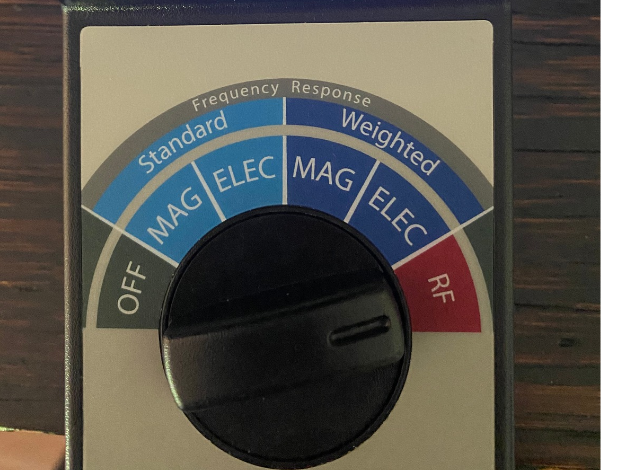
Here is how to tell them apart, with real readings of all three taken in the same room.
Key Takeaways
- RF fields carry wireless signals: WiFi, cell service, Bluetooth. Measured in µW/m² or mW/m².
- Magnetic fields come from current actually flowing, like a running appliance or a power line. Measured in mG or µT.
- Electric fields come from voltage, present anytime something is plugged in, even switched off. Measured in V/m.
- Each field type needs its own meter mode. A reading is hard to interpret unless you know which mode produced it.
Why This Distinction Matters
Most people say “EMF” like it is one thing. It is not. It is a category name for three physically different phenomena that happen to share a section of the electromagnetic spectrum. If you do not know which one you are looking at, a reading is just a number with no story behind it.
Here is what that looks like in practice. Standing in the middle of my living room, in one spot, switching modes: magnetic read 2.2 mG, electric read 0 V/m, and RF caught peaks of 5.94 mW/m² with the live number sitting near 0.13. Same square foot of floor, three completely different answers, and none of them tells you anything about the other two.
Knowing the difference tells you three practical things: what is actually producing the field, how far away you need to be before it fades, and whether shielding it is even realistic. Some fields disappear a few feet from the source. Others pass through walls like they are not there.
RF Fields: Wireless Signals
RF stands for radio frequency. This is the field type behind every wireless technology in your home: WiFi, cell signal, Bluetooth, baby monitors, smart meters, cordless phones.
RF fields are made of waves broadcasting outward from an antenna, carrying information. They are measured in power density, how much signal energy lands on a patch of space, usually shown as µW/m² or mW/m² (1 mW/m² = 1,000 µW/m²). I cover the units in full in How to Read an EMF Meter.
RF fields behave in bursts. A router does not transmit a steady stream; it sends short pulses of data, so the reading jumps around even when nothing in the room has changed. That is normal, not a fault in your meter.
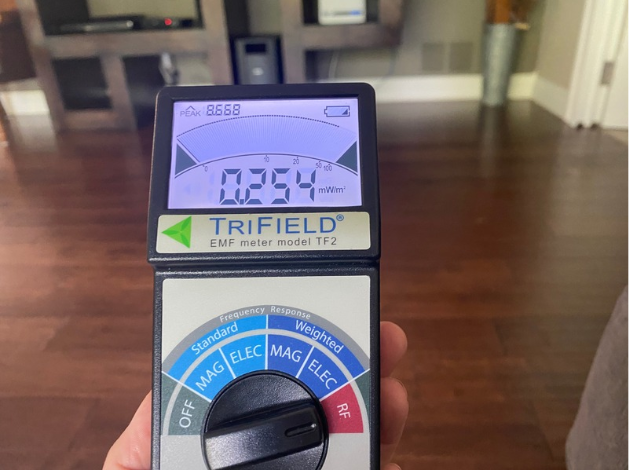
From my own testing: with a TriField TF2 in RF mode one foot from my WiFi router while a video streamed, three of my four readings ran off the top of the display. The TF2 stops at 19.999 mW/m², which is just under 20,000 µW/m², so the level was above that and the meter could not say how far above. Ten feet away, peaks ranged from 0.1 to 7.5 mW/m².
One honest note, because it surprised me. RF does fade with distance, but indoors it does not do it tidily. My readings dropped steeply over the first three or four feet, then sat on a plateau that barely moved from four feet out to thirteen. Both of my meters showed the same shape, so it is the room reflecting signal around, not a meter problem. I go into what distance does and does not buy you in How EMF Weakens With Distance.
Magnetic Fields: Current in Motion
Magnetic fields show up wherever electric current is actually flowing and doing work. A running microwave, a motor, an appliance drawing power, the wiring inside your walls carrying current to an outlet. No current moving, no magnetic field.
These are measured in mG (milligauss) in the US, or µT (microtesla) in most other places and in research papers. The conversion: 1 µT equals 10 mG.
Two habits make magnetic fields distinct from the other two types. They usually fall off quickly with distance from small household sources, and they pass through almost everything, walls included. That second point matters: you cannot shield your way out of a magnetic field the way you sometimes can with an RF signal. Moving away is usually the only real option.
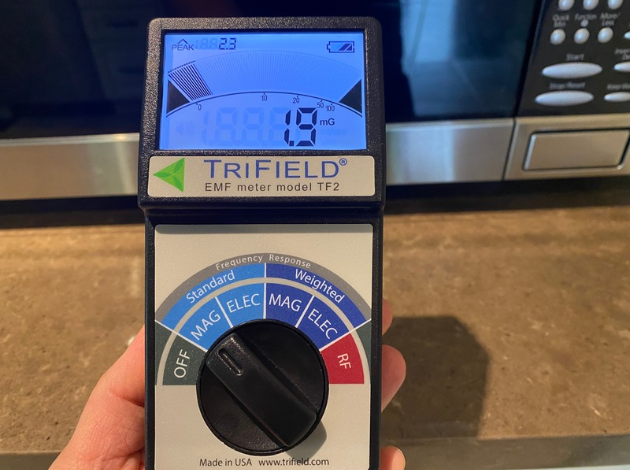
From my own testing: my microwave, running, reads 10 to 13 mG at six inches from the door on the TF2’s magnetic setting, and as much as 24 mG at an inch. At four feet it reads 2.6 to 2.8 mG, which is exactly what my kitchen reads with the oven switched off. The oven is the cleanest example of fast falloff I have measured: strong at the door, gone by the time you have crossed the room.
That background number is worth noticing. My kitchen sits around 2.7 mG with nothing running, and so does the rest of my house, basement included. It is not coming from an appliance and I have not traced it yet. Yours may be much lower.
Magnetic meters are also the right tool for finding wiring errors, mistakes in a home’s wiring that create elevated fields in places you would never expect, like a bedroom wall with no obvious source nearby.
Electric Fields: Voltage at Rest
Electric fields come from voltage, the electrical pressure present the instant something is plugged into the wall. This is the one people miss most, because it does not require anything to be turned on. A lamp that is off, but still plugged in, still has an electric field around its cord.
Electric fields are measured in V/m, volts per meter. Your own body affects the reading, since you conduct electricity, so hold the meter the same way and at the same distance every time you take one.
From my own testing: an inch from my bedside lamp cord, switched off but plugged in, the TF2 in electric mode reads 221 V/m. Switched on, it reads 221 V/m. Unplugged, it reads 0. A foot from the cord it reads 39 to 46 V/m, and in the middle of that same bedroom, away from any cord, it reads 0.
The switch changing nothing is the whole lesson of this field type. The field is voltage sitting in the cord, not current moving through it, so the only thing that touches it is the plug.
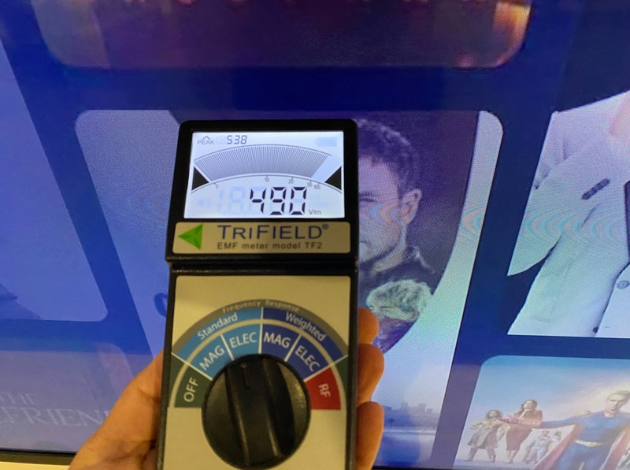
For a bigger source, my basement television read 538 V/m (peaked) with the meter almost touching it, 89 V/m at three feet, and 5 V/m at thirteen. That one falls off about as cleanly as the textbook says it should.
Side by Side
RF fields
- Come from: wireless signals (WiFi, cell, Bluetooth)
- Unit: µW/m² or mW/m²
- Distance: fades, but messily indoors because rooms reflect
- Walls: weakened, but not fully blocked
Magnetic fields
- Come from: current flowing (running appliances, wiring, power lines)
- Unit: mG or µT
- Distance: fades quickly from small sources
- Walls: passes through nearly everything
Electric fields
- Come from: voltage (anything plugged in, on or off)
- Unit: V/m
- Distance: fades steadily, roughly halving as distance doubles
- Walls: mostly blocked by grounded metal and walls
How to Tell Which One Your EMF Meter Is Reading
The mode switch decides this for you, but the giveaway is the source. If it is wireless and not physically wired to anything, it is RF. If it is an appliance that is running or wiring carrying current, it is magnetic. If it is anything plugged in, on or off, it is electric, at least right at the cord.
Walk a room with an all-in-one meter and switch modes at each stop. The number that jumps tells you which field actually matters in that spot, and as my living room showed, the three modes can give you three unrelated answers from the same square foot.
Frequently Asked Questions
Which field type should I worry about most?
None of them individually deserves worry over the others; each just needs its own measurement. RF is usually what people mean when they ask about WiFi or cell signal. Magnetic is the one tied to power lines and appliances. Electric is the overlooked one in bedrooms. I lay out what each one reads in a real house in What Is a Normal EMF Reading in a House?.
Can one meter read all three?
Yes. All-in-one meters like the TriField TF2 and the GQ EMF-390 have a mode switch that changes which sensor is active. I explain the tradeoffs of an all-in-one versus a dedicated single-purpose meter in What Is an EMF Meter and Which Type Do You Need?.
Why does my meter show different numbers in the same spot?
Check which mode it is in first; that alone explains most confusion. After that, RF readings naturally swing because devices transmit in bursts, so a changing number in RF mode is expected. Magnetic and electric readings should be steadier once you are away from something switching on and off.
Once you can tell the three fields apart, the next useful thing to learn is how fast each one actually fades as you step back, which is measured out in How EMF Weakens With Distance. The rest of this pillar lives on the Understanding EMF hub.
Related Reading
- What Is EMF? Ionizing vs. Non-Ionizing, in Plain Words
- How EMF Weakens With Distance
- Meter Frequency Range: Why It Matters
- How to Read an EMF Meter: What the Numbers and Units Mean