The TriField TF2 is the meter I reach for first, and the one I hand people who ask what to buy with no further questions. It reads all three field types, its magnetic sensor is three-axis so the angle of your wrist cannot ruin a reading, and it does the one thing a first meter has to do: give a beginner a number they can trust on day one, without a manual in the other hand.
It is not perfect, and two of its limits are worth knowing before you buy. But as the single meter to own, it has earned its place at the top of my kit. Tested by me. I own it and bought it myself. Affiliate disclosure: some links here are affiliate links. Buy through one and I may earn a small commission, at no extra cost to you.
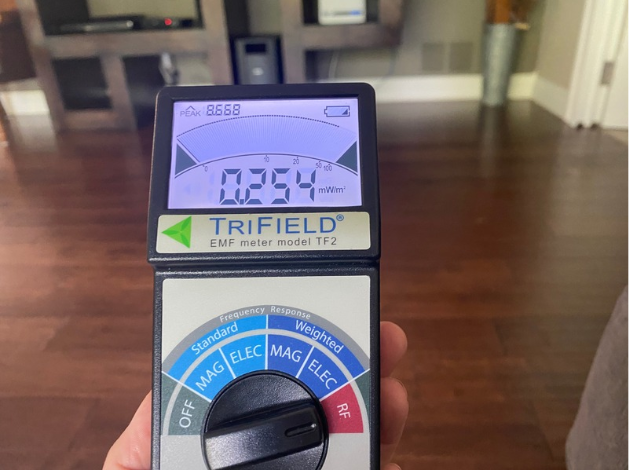
Best for: first-time buyers and whole-home walkthroughs, where simple operation and a trustworthy magnetic mode matter more than logging or advanced RF features.
The Short Version
Three situations call for a different meter, and none of them is likely to be you:
- You only care about WiFi and cell signal, and want to see very faint levels. A dedicated RF meter like the Safe and Sound Pro II does that better, and costs several times as much.
- You want to leave a meter running overnight and chart what happened. That needs logging, which the TF2 doesn’t have. The GQ EMF-390 does, for less money.
- You specifically need millimeter-wave 5G. No all-in-one reaches that band. The Safe and Sound Pro mmWave is built for it. I don’t own one, so that recommendation rests on its specs rather than my readings.
If none of those is you, stop reading comparisons and buy this one.
The Specs
| Maker | AlphaLab, USA |
| Magnetic | Three-axis, milligauss (mG), ±4% |
| Electric | Single-axis, volts per meter (V/m), ±5% |
| RF | Single-axis, milliwatts per square meter (mW/m²), ±20% |
| RF range | 20 MHz to 6 GHz |
| Display | Live number plus a peak-hold bar |
| Power | One 9V battery |
| Logging | None |
Verify current figures against AlphaLab’s own sheet before relying on them; manufacturers revise models.
Two of those lines deserve translation. Three-axis magnetic means the meter reads the field from all directions at once, so you can hold it however is comfortable and trust the number. The accuracy figures differ per mode for a reason: the magnetic sensor is the precise one and the RF sensor is the rough one, which shapes how much weight to put on each kind of reading.
What It’s Like to Use
One dial. That is the whole interface, and it is the best thing about the meter.
You turn the knob to the field you want, the screen shows a number and a unit, and a bar along the top holds the highest value it has seen. There is an audio click that speeds up as a field strengthens, which sounds like a gimmick and turns out to be the feature I use most: you can sweep a whole room by ear, watching where you’re walking instead of watching a screen, and only stop to read the display when the clicking changes.
The dial has six positions, including separate standard and weighted settings for magnetic and electric. Standard is the one whose numbers compare against published reference levels, so standard is what I measure and publish in unless I say otherwise. I have never had a reason to use weighted.
It takes about two minutes to learn and you will not misread what mode you are in, because the dial is physical and labelled. That sounds like a small thing. Compared with a menu-driven meter, it is not.
The build is the boring kind of good: solid plastic, a battery door that stays shut, and a manual that actually explains what the modes do. AlphaLab has been making field meters for decades and it shows in the unglamorous parts.
Where the Three-Axis Magnetic Mode Earns Its Keep
This is the single best reason to own this meter.
A single-axis magnetic meter has to be rotated to find the strongest angle, and a beginner who doesn’t know that will under-read a field without ever realising. The TF2 removes that failure mode. You point it in roughly the right direction and the number is the number.
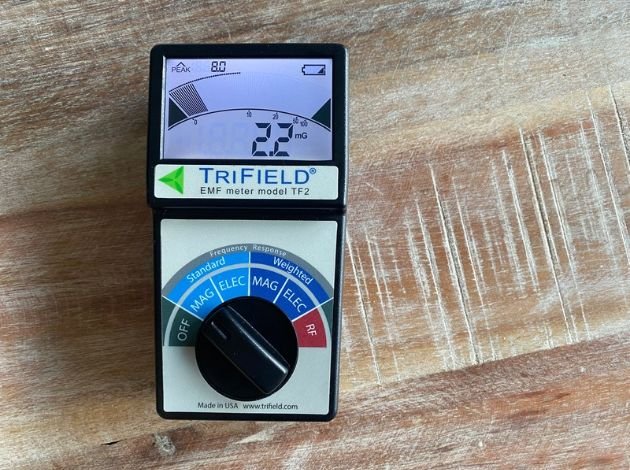
In practice it means you can walk a wall, trace a field back to the appliance causing it, and compare one room against another without worrying that your technique changed between readings. In my own house the magnetic mode is what found a 2 to 4 mG background sitting in every room, basement included, with nothing switched on. I have not yet traced where it comes from, but I would not have spotted the pattern at all with a meter that reads differently depending on how I hold it.
One honest caveat: at very close range, within an inch or two of a strong source, moving the meter still changes the reading, because the sensors sit inside the body of the device and an inch of travel matters when a field is falling away steeply. Pointed at my running microwave at one inch it read 20 mG; tilted up at the same inch, 13 to 15. That isn’t the three-axis claim failing, it’s a reminder that position and orientation aren’t the same thing.
If that’s the part you care about, and for most first-time buyers it should be, the TF2 is the one to get.
Where It Falls Short
RF mode is single-axis. Pointing matters, and a careless sweep under-reads. In my own living room, standing still and only changing which way I pointed it, readings went from 0.03 to 3.5 mW/m². Once you know that, you work with it, but the point-anywhere confidence of the magnetic mode does not carry over. If RF is your specific concern rather than one of three, the Safe and Sound Pro II reads far fainter signals and doesn’t make you think about angle.
It stops at 6 GHz. That covers WiFi, Bluetooth, and the 5G most people actually have. It does not cover millimeter-wave 5G above 24 GHz, which needs a meter built for that band.
No logging. What you see is what you write down. If you want to know what happened overnight, this is the wrong meter.
The RF display ceiling is 19.999 mW/m². One foot from my router under load, three of my four readings ran off the top of the scale. That tells you the level was above the ceiling and nothing about how far above, which is genuinely frustrating when you’re close to something strong.
None of these are dealbreakers for the meter’s actual job. They are the reasons a second, specialised meter eventually makes sense for some people, and the reason my own kit has more than one in it.
A Few Readings, as Proof
I am not going to bury you in numbers, but a review with none is just an opinion. All of these came off my TF2 in my own home in August 2026.
| What | Reading |
|---|---|
| Running microwave, 6 inches | 10 to 13 mG |
| Same microwave, 4 feet | 2.6 to 2.8 mG, same as the room |
| Lamp cord, 1 inch, lamp switched off | 221 V/m |
| Same cord, 1 foot | 39 to 46 V/m |
| Middle of the bedroom, away from cords | 0 V/m |
| Router at 1 foot, streaming | over the 19.999 mW/m² ceiling |
The lamp is the one that taught me something. Switching the lamp on changed the reading by nothing at all; unplugging it took it to zero. The field comes from voltage sitting in the cord, not from current flowing through it, and the TF2 showed that plainly enough that I understood it before I had read why.
TF2 vs. the Obvious Alternative
The other meter I use constantly is the GQ EMF-390. It costs less, adds data logging and a band-indicating RF display, and gives up some of the TF2’s simplicity and magnetic-mode confidence to do it.
The short version: TF2 for the person who wants one dependable meter and clean readings. EMF-390 for the person who wants to log and tinker.
Running both on the same sources, they agreed on the shape of every curve and disagreed on the values, by about threefold on electric field. Two meters disagreeing on a number while agreeing on a pattern is the single most useful thing I have learned from owning both.
Who Should Buy It, and Who Shouldn’t
Buy it if you are measuring a home: first meter, bedroom checks, appliance tracing, before-and-after tests.
Skip it if your primary interest is RF analysis, logging readings over time, or chasing signals above 6 GHz. Those jobs belong to dedicated meters at dedicated prices, and no all-in-one does them properly.
Frequently Asked Questions
Is the TriField TF2 accurate?
Its stated accuracy differs by mode: ±4% for magnetic, ±5% for electric, ±20% for RF. Those are the figures AlphaLab publishes, and they tell you how much weight to put on each kind of reading. For home measurement what matters is repeatability for comparisons, not laboratory metrology, and the magnetic mode in particular is consistent enough to compare one room against another with confidence.
Does the TF2 detect 5G?
It sees the sub-6 GHz bands that carry 5G for most people. It cannot see millimeter-wave 5G above 24 GHz, which needs a meter built for that band.
What is the difference between standard and weighted modes?
Standard mode reads field strength the conventional way, and its numbers are the ones to compare against published reference levels. Weighted mode emphasizes higher frequencies within the meter’s range. Unless you have a specific reason otherwise, measure and log in standard.
What battery does it use?
One 9V. Battery life is long enough that I carry a spare out of habit rather than need. A low battery is worth ruling out any time readings act strange, on any meter.
Can the TF2 measure dirty electricity?
No. Dirty electricity is high-frequency noise riding on house wiring, and it needs a meter that plugs into an outlet. The TF2 measures fields in the air around you, which is a different job.
Ready to buy? Check the current price on Amazon.
Related Reading
- How I Test
- What Is a Normal EMF Reading in a House?
- Single-Axis vs. Three-Axis Meters
- How to Read an EMF Meter: What the Numbers and Units Mean