EMF stands for electromagnetic field. It is energy that travels through space around anything electrical or wireless: your phone, your WiFi, your wiring, the power lines outside.
All EMF falls into one of two categories, and the difference between them matters more than anything else on this topic. Ionizing radiation, like X-rays, carries enough energy in a single wave to knock electrons loose and break molecules apart. Non-ionizing radiation, which is everything in your home, doesn’t carry enough energy per wave to do that. Whether it can cause damage some other way is a separate question, and researchers are still working on it.
If you understand that one dividing line, you already know more than most of the internet arguing about this. Here it is in plain words.
Key Takeaways
- EMF is energy given off by anything electrical or wireless. It is invisible, but it is measurable.
- The one distinction that matters: ionizing radiation carries enough energy in each wave to break chemical bonds directly. Non-ionizing radiation doesn’t. Whether it can do harm some other way is a separate and open question.
- Everything in your home, WiFi, phones, power lines, microwaves, gives off non-ionizing radiation.
- Non-ionizing does not mean “nothing to think about.” It means the conversation is about exposure levels and personal choices, not X-rays.
EMF in Plain Words
Think of a pond. Drop a stone in, and ripples spread out from the splash. EMF works the same way: anything carrying electricity or sending a wireless signal makes invisible ripples in the space around it. Those ripples are the field.
The ripples get weaker as they spread, which is why distance matters so much with EMF. I measured that effect directly, and found it messier indoors than the textbook suggests, in Does EMF Get Weaker With Distance?
Different sources make different kinds of ripples. Your wiring makes one kind, your WiFi makes another. I break those apart in RF vs. Magnetic vs. Electric Fields. For this article, one idea covers them all: energy, moving through space, in waves.
The Spectrum, From Radio Waves to X-Rays
All of these waves live on one long line called the electromagnetic spectrum. What changes along the line is frequency: how fast the wave wiggles.
At the slow end sit radio waves, the kind your WiFi and phone use. In the middle sits visible light. Yes, ordinary light is part of the same family. At the fast end sit ultraviolet, X-rays, and gamma rays.
Here is the rule that makes the whole spectrum make sense: the faster the wiggle, the more energy each wave carries. Radio waves carry very little energy per wave. X-rays carry enough to knock pieces off the atoms they hit.
The Dividing Line: Ionizing vs. Non-Ionizing
Somewhere past visible light, in the ultraviolet range, the waves start carrying enough energy to knock electrons off atoms. That is called ionizing, and it is the property that lets X-rays and gamma rays damage DNA. It is why the dentist steps out of the room, and part of why heavy sun exposure raises skin cancer risk.
Everything below that line is non-ionizing. However strong the signal, each individual wave carries too little energy to break a chemical bond directly, and stacking up more weak waves doesn’t change that, according to the NIEHS and the WHO.
What that rules out is one specific mechanism: the direct bond-breaking that makes X-rays dangerous. It does not rule out other routes.
The main one researchers are looking at is oxidative stress. The idea is that RF exposure could increase reactive oxygen species inside cells, and those molecules can damage DNA without any direct bond-breaking. There is a real body of peer-reviewed work reporting this effect in cell and animal studies. A 2021 review by Schuermann and Mevissen found consistent evidence of EMF-induced reactive oxygen species formation in experimental research, with most animal studies and many cell studies showing increased oxidative stress.
The same authors are clear about the limit of that finding: judging what it means for human health also requires human studies and population research, which is where the picture gets much less settled.
What that research has not established is whether it translates into harm in people at everyday exposure levels. Bodies like the WHO and ICNIRP have reviewed it and concluded the evidence isn’t strong enough to change exposure limits, and researchers who disagree have said so in the literature. That is an open argument, not a closed one, and I’d rather tell you that than hand you a tidy answer in either direction.
Every source in your home sits far below that line. WiFi, cell signals, Bluetooth, power lines, your microwave: all non-ionizing. That is a statement about frequency, not a verdict on safety. The main established effect of strong non-ionizing radiation is heating, which is what a microwave oven does on purpose, at power levels enormously higher than anything else in your house.
So Is the Conversation Over? Not Quite
Some sites use “non-ionizing” to end the discussion, and some use scary spectrum charts to start a panic. I think both are lazy.
The honest version: the official exposure limits from the FCC are built around that heating effect and date to 1996, and home exposures sit far below them. Below the heating level, the research is live rather than finished: animal studies have reported effects, the WHO’s cancer agency classifies RF as “possibly carcinogenic” (Group 2B), and a 2021 court ruling ordered the FCC to better explain keeping its limits. None of that proves harm; all of it means the honest phrase is “open question,” not “case closed.”
My own approach lives in that gap. When lowering an exposure is free or easy, I do it without needing much convincing. When it costs real money, I think harder about it, and sometimes I spend it anyway. I lean closer to what building biologists recommend than to the official limits. That is a personal margin, not a medical claim.
The stricter benchmark I lean toward, and what it does and doesn’t claim, is laid out in Building Biology Standards (SBM-2015), Explained. Where you draw your own line is up to you, and the readings from a real house are in What Is a Normal EMF Reading in a House?
Where an EMF Meter Fits In
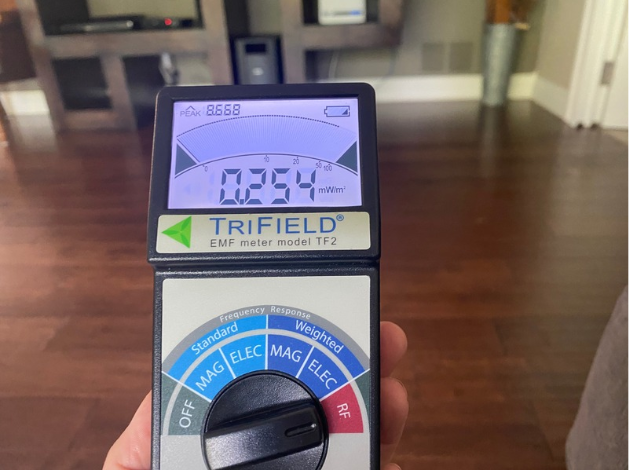
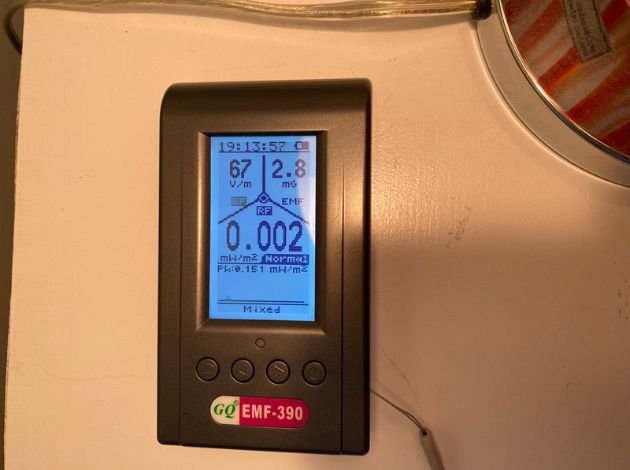
You cannot see any of this, but you can measure all of it. A home EMF meter reads the non-ionizing fields around you and turns them into numbers you can compare, track, and act on. That is the whole idea behind this site.
If you are starting from zero, What Is an EMF Meter and Which Type Do You Need? is the next page to read, and if you already know you want one, my tested picks are on the front page. One warning repeated from that first article because it matters: home EMF meters do not detect ionizing radiation. A product that blurs the line between the two is telling you something about the seller.
Frequently Asked Questions
Is WiFi ionizing radiation?
No. WiFi uses radio waves at 2.4 and 5-6 GHz, far below the ionizing threshold, which sits up past visible light in the ultraviolet range. So WiFi doesn’t carry enough energy per wave to break DNA bonds the way X-rays do. That answers one specific question about one specific mechanism, and it doesn’t by itself settle what any particular exposure is worth doing something about.
Is EMF the same thing as radiation?
“Radiation” just means energy traveling outward from a source. Light from a lamp is radiation. Heat from a campfire is radiation. The word sounds alarming because we associate it with the ionizing kind, but by itself it says nothing about danger. EMF from home devices is non-ionizing radiation, which tells you which category it belongs to. It doesn’t by itself tell you whether any particular exposure is worth doing something about.
Does EMF go through walls?
It depends on the field type and on what the wall is made of. Radio signals pass through drywall and wood weakened but usable, which is why your WiFi works upstairs. Concrete, brick, and especially metal block a lot more of them, which is why signal drops in a basement or a steel-framed building, and it’s the same principle behind shielding fabrics and Faraday bags. Magnetic fields are the stubborn ones: they pass through nearly everything, including metal, which is why they can’t practically be shielded in a home. Either way, distance keeps weakening the field, and I measured how fast in Does EMF Get Weaker With Distance?
Is non-ionizing radiation safe?
The FCC, ICNIRP, and WHO hold that exposures within the official limits are not shown to cause harm. Those limits are built around heating effects: the FCC’s date to 1996, and ICNIRP’s to 1998 with the radio-frequency part revised in 2020. Research below the heating level is ongoing, with results that keep the question open. I show you the official limits, the stricter precautionary targets building biologists use in Building Biology Standards (SBM-2015), Explained, and what I measure in my own home, so you can draw your own line.
Now that the big distinction is clear, the next step is learning to tell the three household field types apart, because they come from different sources and behave differently. That is covered in RF vs. Magnetic vs. Electric Fields: What’s the Difference? The rest of this section lives on the Understanding EMF hub.
Related Reading
- RF vs. Magnetic vs. Electric Fields: What’s the Difference?
- Does EMF Get Weaker With Distance?
- Building Biology Standards (SBM-2015), Explained
- What Is an EMF Meter and Which Type Do You Need?